

Why Free Trials Are the Ultimate Trust Test
In the SaaS ecosystem, providing a free trial isn’t a marketing strategy; it’s a critical point where trust is established or destroyed. Users aren’t simply testing your product; they’re considering whether or not it can get the job done. A well-designed free trial can lead to higher conversion rates, while a poorly executed one can result in missed opportunities.
What Makes a Trial Convert? (It’s Not What You Think)
The Real Definition of a High-Converting Trial
Many assume that showcasing a plethora of features will impress users. However, users are more interested in how quickly they can achieve their goals using your product. The focus should be on delivering value swiftly, guiding users to their “aha moment” where they realize the product’s worth.
The 5 Core Metrics Behind Trial Conversion Strategy
- Activation Rate: Percentage of users who complete key actions that indicate they’re deriving value.
- Time-to-Value (TTV): How quickly users reach their first success with the product.
- Aha Moment Reach%: Proportion of users who experience the core value proposition.
- Engagement Depth Before Paywall: Extent of user interaction with the product before encountering limitations.
- Free-to-Paid Conversion Rate: Percentage of trial users who become paying customers.
Mapping the Aha Moment: The Heart of Any Trial That Converts
How to Identify Your Real “Aha”
To identify the “aha moment,” examine the user behavior of those who upgraded from free trials to paid plans. Look for common actions or features that they interacted with early on. This information is useful in optimizing the onboarding process to lead new users to these critical experiences.
The Aha Moment Playbook
- What it feels like: A clear realization of the product’s value.
- How to design for it: Highlight key features early in the trial.
- How to test for it: Use A/B testing to determine which onboarding flows lead to higher activation rates.
- How to surface it early: Simplify the initial user journey to lead directly to the core value proposition.
Structuring Your Trial Like a Movie (Not a Menu)
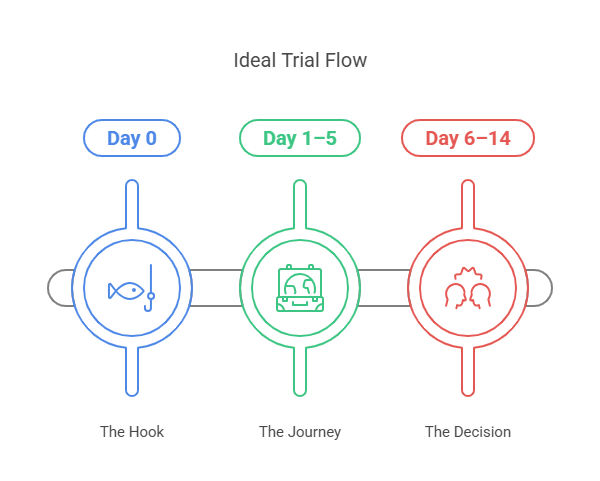
From Signup to Success: The Ideal Trial Flow
Act 1 – The Hook (Day 0)
- Implement an emotional onboarding experience that resonates with users’ needs.
- Utilize heatmaps and behavior analytics to optimize initial interactions.
- Provide quick wins through setup flows that demonstrate immediate value.
Act 2 – The Journey (Day 1–5)
- Create momentum loops with microtasks leading to microrewards.
- Incorporate nudge strategies like empty states, celebration moments, and gamified engagement.
- Draw inspiration from companies like Calendly and Duolingo for effective engagement tactics.
Act 3 – The Decision (Day 6–14)
- Present value-driven content before introducing pricing.
- Monitor intent signals, such as usage thresholds that predict upgrade behavior.
- Balance scarcity and empowerment through email nudges, upsell modals, and usage reminders.
Free Trial UX: The Micro-Decisions That Drive Macro Conversions
UX Patterns That Convert Trial Users
- Implement progress bars to visualize user advancement.
- Design personalized onboarding sequences tailored to user needs.
- Set smart defaults to reduce decision fatigue.
- Craft instant gratification microcopy to encourage continued use.
- Ensure frictionless integrations with other tools.
3 Deadly UX Sins That Kill Trial Conversions
- Avoid overwhelming dashboards that confuse users.
- Steer clear of generic, one-size-fits-all calls to action.
- Don’t gate valuable features before establishing trust.
Trial Models Breakdown: Which One’s Right for You?
Types of Free Trials
- Opt-in (No card required): A lower barrier to entry, suitable for early-stage PLG companies.
- Opt-out (Card required): Higher commitment, often used by B2B mid-market SaaS.
- Usage-based trial: Limits based on usage metrics, ideal for developer tools.
- Hybrid models: Combines elements of the above, as seen with companies like HubSpot.
Table: Free Trial Models vs Conversion Outcomes
| Trial Model | Conversion Rate Trend | Best For | Example SaaS |
| Opt-in (No card) | Low to Medium | Early-stage PLG | Notion, Trello |
| Opt-out (Card) | Medium to High | B2B Mid-Market | Shopify, Salesforce |
| Usage-based trial | High | Developer Tools | Postman, Mixpanel |
Emails That Convert: Communication Throughout the Trial Period

The Trial Email Sequence Blueprint
- Welcome + expectation setting: Introduce the product and set clear expectations.
- Aha moment booster (Day 2–3): Highlight key features that lead to value realization.
- Mid-trial value summary: Summarize the benefits experienced so far.
- End-of-trial urgency + benefit reminder: Encourage conversion before the trial ends.
- Post-trial re-engagement: Reach out to users who didn’t convert, offering additional incentives or assistance.
Real Examples of Free Trials That Nail It (And Why)

Example of Free Trials
- Loom: Offers emotionally guided quick wins by enabling users to record and share videos effortlessly.
- Linear: Provides instant usability with minimal setup friction,
- Miro: Provides strong visualization of the aha moment within the first session, showing users immediate possibilities.
- Basecamp: Delivers an anti-feature overload approach, emphasizing simplicity and ease, not overwhelming options.
What You Can Steal:
- Visual Storytelling: Demonstrate what’s possible with rapid visuals or tours.
- Emotional Hooks: Engage on a human level, emotively instead of merely functionally.
- Real Projects, Not Demos: Let users dive into realistic use cases immediately rather than artificial sandbox environments.
Final Take: Free Trial, ≠ Free Ride
Remember, offering free trials isn’t about letting users browse aimlessly. Your strategy should help users quickly grasp real value, transforming casual free users into paying customers. Focus on clarity and instant gratification rather than just feature dumps. High conversion rates come naturally when users genuinely feel they’re becoming better versions of themselves through your SaaS product.
FAQs: Designing Free Trials That Actually Convert
What’s a good free trial conversion rate?
Typically, SaaS companies see free trial conversion rates of around 15–25% for opt-in free trials, while opt-out free trials often convert free users at a higher rate, roughly 30–50%. Benchmark your performance against these standards to determine your success.
How do I know if users have reached the aha moment?
Analyze user behavior closely. Look for clusters of actions like frequent use of key features, interactions that directly correlate with high conversion rates or even noticeable spikes in session durations. Tools like Mixpanel or Amplitude can provide deep insights here.
Should we gate core features during the trial?
Avoid gating your best features unless absolutely necessary. Leading with strong, engaging features allows users to understand your SaaS product’s value faster, helping to convert free trial users into paying customers more effectively.
What tools can I use to track trial behavior?
The best SaaS companies rely on tools like Mixpanel, Heap, Amplitude, FullStory, or Hotjar. These analytics platforms can provide comprehensive insights into user interactions, conversion strategy effectiveness, and areas needing optimization.