

Why Attribution Feels Broken in 2026
Most people feel trapped with attribution. Some can’t keep up with what really causes conversions, and others have to work with legacy tools that never account for all marketing touchpoints. There’s a feeling that the world continues to change, but most models remain in the past. People often toss around phrases like first-touch attribution or multi-touch attribution and hope something sticks. That’s where marketing attribution is the way to make sense of where credit really belongs. If an attribution model fails to show which marketing activities matter most, there’s no easy way to defend ROI.
What Is a Marketing Attribution Model (And Why It Matters More Than Ever in 2026)?

Definition
A marketing attribution model is a framework that assigns credit to different marketing channels or touchpoints in the buyer journey. In simple terms, you’re looking at everything from that first LinkedIn click to the final email marketing campaign that closes the deal. When folks talk about different attribution models, they’re comparing how each model assigns a slice of credit to each interaction. The goal is to know which marketing efforts truly matter.
Why 2026 Demands New Thinking
Things keep shifting fast. Privacy regulations, AI-driven ads, and shorter attention spans all mix together in digital marketing. That means last year’s approach might miss key data points. You also have multiple marketing channels competing for attention, and you don’t want your single-touch attribution model or even a simpler linear attribution model to overlook some hidden path to conversion. This is where a variety of attribution models can shine.
Key Role in Budget Justification
Marketing attribution helps you show stakeholders why a specific marketing channel deserves more investment. If your model is accurate, you can highlight the real cost per acquisition and the best path for ROI. Using attribution in your sales and marketing reports can give you a leg up in budget conversations. Without a way to compare different attribution models, it’s tough to prove which approach will work best.
Example
Imagine a B2B funnel: your team sends an email, the prospect views a LinkedIn Ad, and then views a webinar before asking for a demo. Eventually, they sign on the dotted line. Which touchpoint had the greatest impact? If you only rely on last-touch attribution, you might say the demo call was the single hero. But that shortchanges the earlier marketing activities that warmed them up. That’s why many folks look at multi-touch attribution to spread credit more evenly.
The Core Types of Attribution Models (And When Each One Backfires)
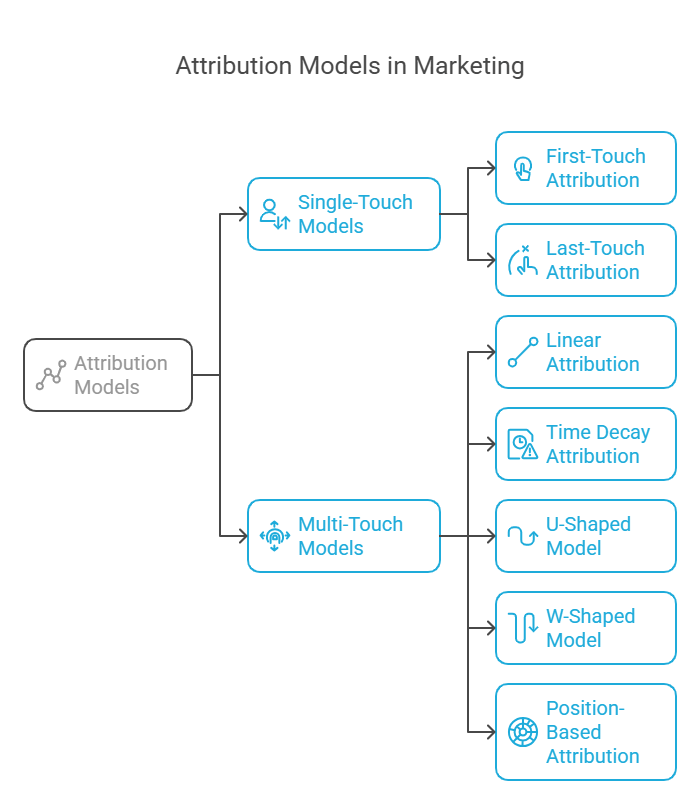
Single-Touch Models
First-Touch Attribution
Some call it the simplest type of attribution. The model assigns all credit to the first marketing touch that got the prospect’s attention. It’s best to use when you care about top-of-funnel awareness and you want to see which channel initially grabbed the lead. However, first-touch attribution struggles when you have a long B2B funnel that spans months. A single source attribution model can ignore the later interactions that push someone to sign.
Last-Touch Attribution
Last-touch attribution does the opposite. It awards full credit to the final touch before conversion. This model may help when your funnel is short, and decisions are quick. However, a longer funnel often needs more nuance. If you rely only on last-touch attribution, you’ll miss everything that happened in the early and mid stages.
Visual Table: Think of a quick chart that compares first-touch vs last-touch attribution. For brand awareness campaigns, the first touch might make sense. For immediate purchases, the last touch can be enough. But both can fail for more complex journeys.
Multi-Touch Attribution Models
Linear Attribution
Linear attribution spreads credit evenly across all touches. If there were five points along the way, each would get 20 percent. Some find this approach appealing because it’s easy to understand. But it can be an oversimplification. If you have a digital marketing push plus an email marketing campaign plus a webinar, this model might overvalue a tiny interaction that has little real impact.
Time Decay Attribution
Time decay attribution assigns greater weight to more recent behavior. The model suits funnels when the last interactions are the strongest. Consider a three-month period. The later weeks may be the most important interactions, so time decay attribution can focus on what closed the sale. The flip side is that initial interactions receive less weight, which may negatively impact your awareness campaigns.
U-Shaped / W-Shaped Models
U-shaped attribution highlights the very first touch and the final conversion. If someone finds you through a marketing channel like LinkedIn and then later fills out a form, those two interactions get more weight. W-shaped takes it further by adding a little love for a mid-funnel milestone (like a product demo). These types of marketing attribution can be more balanced, but they can also feel complex.
Position-Based Attribution
Position-based attribution sometimes called the 40-20-40 model, splits credit between the first and last interactions while distributing the remainder across middle touches. Full-funnel marketers sometimes find this helpful, but it can still miss certain micro-touchpoints.
Visual Chart: Imagine a side-by-side comparison of linear, time decay, U-shaped, W-shaped, and position-based. All methods have strengths and weaknesses. Some advertisers like multi-touch attribution because it measures a larger chunk of reality.
Advanced/Data-Driven Attribution
Machine-Learning Based Attribution
Some, such as Google Ads or more sophisticated platforms, use machine learning to determine which interactions are most significant. This can be particularly beneficial for online marketing with large volumes of clicks. Data-driven models seek to be more precise by observing actual patterns. They search for the shared paths that drive conversions and then compare attribution models automatically behind the scenes.
Custom Attribution
A custom attribution model is where you build your own rules to fit your funnel. Some organizations have unique metrics or want to track multiple marketing channels in one giant system. A custom attribution model may solve these needs if you have the tech resources. Although it sounds perfect, it can be tricky if your data isn’t clean or your marketing teams aren’t aligned.
How to Choose the Best Attribution Model for SaaS in 2026

Ask Yourself These 5 Questions
- How long is our funnel? If it’s short, single-touch might be okay. If it’s a marathon, you might want multi-touch.
- How many marketing channels do we use? More complexity often calls for advanced multi-touch attribution.
- What metrics do stakeholders want? If leadership focuses on top-of-funnel leads, the first touch might matter. If they care about conversions at the last step, that changes the conversation.
- Do we need speed or deep insight? If you need quick directional info, linear might be fine. If you crave detail, consider something like a time decay attribution model or a position-based attribution model.
- Do we have enough marketing data to drive an advanced or custom attribution model? Without robust tracking, it can be tough to run a machine-learning model.
Framework: The “Attribution Fit Matrix”
Picture a table with funnel length on one axis and marketing complexity on the other. A single-touch attribution model might work for low complexity and short timelines. A multi-touch model is best for bigger deals with multiple marketing touchpoints. If you want to compare, you can do a quick exercise with your own marketing efforts.
Real-World Marketing Attribution Examples from B2B Funnels

Example 1: Cybersecurity Product with a 3-Month Sales Cycle
They employed LinkedIn advertising to build brand awareness, presented a case study afterwards, and then emailed to nurture leads. Last was a sales demo that sealed the deal. They attempted single-touch attribution and found they were missing all the mid-funnel touches. They moved to a hybrid model that blended time decay with position-based attribution, which demonstrated to them how every step played a role.
Example 2: SaaS Platform Using Paid plus Organic Mix
They had so many marketing channels at once that everything blurred. They used a custom attribution model with data-driven insights from Google Ads and their CRM. This helped them track marketing ROI effectively and see which mid-funnel steps had the biggest impact.
What They Got Wrong Before Switching Models
Some believed the first-touch attribution model was enough, but that neglected the events in the middle. Others tried the last non-direct click attribution and discovered it gave zero credit to their top-of-funnel efforts. Those lessons turned into shareable stories that highlight why comparing different attribution models matters.
First-Touch vs Last-Touch vs Multi-Touch: What Works Best in 2026?
| Attribution model | Pros (why marketers like it) | Cons (watch-outs) | Best funnel fit | When to reach for it |
| First-touch | Pinpoints the top channel that sparks brand awareness • Simple to explain to stakeholders | Ignores every mid- and late-stage action • Skews credit in long SaaS cycles | Short, simple funnels or pure TOFU lead-gen | You’re running big awareness pushes (podcasts, PR blasts) and need to see which channel grabs the first click |
| Last-touch | Spotlights the final conversion trigger • Matches how many CRM tools report by default | Writes off nurture steps that warmed the deal • Can favour high-intent pages and undervalue content | Transaction-style funnels or high-velocity freemium sign-ups | You’re tweaking landing pages or checkout UX and want to isolate end-game wins |
| Linear (even-split) | Every touchpoint gets a slice of credit • Easy starter multi-touch model | Overvalues low-impact touches • Hard to see which steps truly move the needle | Medium-length B2B funnels with 4-6 touches | You want a quick sense of full-journey engagement before upgrading to something smarter |
| Time-decay | Gives extra weight to touches closest to the deal-close • Great for late-stage optimisation | Early awareness steps get muffled • Needs reliable timestamp data | Longer-cycle deals where last-mile nudges matter (price quotes, demos) | You’re scaling SDR follow-ups or late-stage retargeting and need to prove impact fast |
| U-shaped (40-20-40) | Rewards first and last touches while saving room for lead-capture | Can miss subtle mid-funnel nurtures • Fixed weightings aren’t always fair | SaaS funnels where the form fill is a clear “aha” moment | You’re tracking a clear lead-capture event (ebook, webinar) plus demo request |
| W-shaped | Adds extra credit for the big middle milestone (e.g., sales-qualified lead) | Still fixed weights • Can feel complex to explain | Enterprise funnels with a pivotal sales-assist call | You need to highlight marketing’s role at the hand-off to sales |
| Position-based (custom 40-20-40 or similar) | Lets you tune weightings to match real buyer behaviour | Requires alignment across teams • Still rule-based vs data-driven | Any funnel where three moments clearly dominate | You’ve mapped the journey and want a “set-and-forget” hybrid of human logic + simplicity |
| Data-driven / machine-learning | Learns from actual conversion paths • Adapts as campaigns change | Needs high volume + clean data • Opaque “black-box” output can spook execs | High-traffic digital campaigns with many stochastic paths | You’re spending big on ads and want statistically grounded credit assignment |
| Custom / hybrid | Built for your exact stack, KPIs, and stakeholder quirks • Scales with new channels | Dev-heavy • Falls apart if tracking breaks | Complex SaaS or cybersecurity orgs with >6 channels and multi-quarter cycles | You need bulletproof board-level reporting and can invest in advanced analytics |
Multi-Touch Emerges as Leader (But Not Always)
A multi-touch attribution model often gives a more complete view of the buyer journey. However, if your business is small and your funnel is quick, that level of detail might be overkill. Large B2B organizations with multiple marketing channels typically benefit from a multi-touch approach. On the other hand, smaller teams that want to get started fast might pick a simpler approach first, then evolve as they gather more data.
Bonus: W-shaped and Time Decay vs Linear Attribution
One team tested a W-shaped vs a linear attribution model and found that the W-shaped offered a better peek at key mid-funnel actions. Another tested the time decay attribution model, which showed how late-stage marketing activities often pushed leads to sign. The conclusion was that each model works if it matches the funnel and goals.
Tools That Make Attribution Models Less Painful in 2026
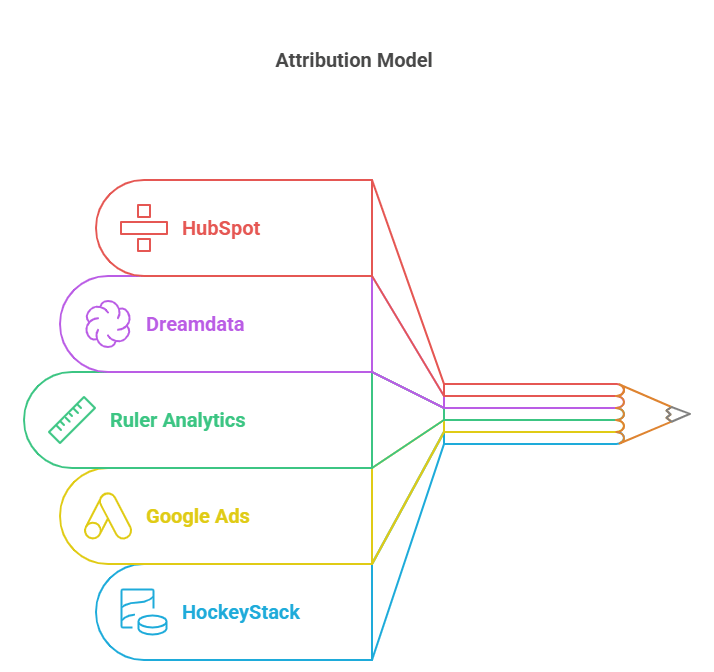
Top 5 Tools for B2B Marketing Attribution
- HubSpot: Good for smaller marketing teams or those who like an all-in-one setup.
- Dreamdata: Tailored for B2B funnels that need advanced tracking.
- Ruler Analytics: Can unify multiple marketing channels into one view.
- Google Ads Data-Driven Attribution: Great if you run big campaigns on Google Ads and want to see how each click attribution plays out.
- HockeyStack: Ideal for advanced SaaS insights when you want to see funnel metrics with real clarity.
Budget-Savvy Alternatives
Some folks do everything with Google Analytics 4 and UTM tags. This is a hands-on way to track marketing ROI effectively without fancy software. You won’t get the depth of a custom attribution model, but you can still see whether your marketing campaign is delivering results.
Downloadable Comparison Chart
A quick chart that details features, pricing, and integrations can help you decide which tool is right for your business. This chart might be especially helpful for those on the fence about whether to invest in advanced solutions or stick to basics.
How to Track Marketing ROI Effectively (Without Drowning in Data)

Track What Matters
Focus on the marketing touchpoints that connect to actual revenue. That means looking at funnel progression, cost per touch, and correlation between stages and deals closed. If you fill your dashboard with random vanity metrics, you might miss the real driver of ROI.
Common Mistakes to Avoid
One common misstep is putting too much weight on last-click attribution, ignoring dark social or brand-building steps. Another is failing to measure mid-funnel engagements, which can cause the team to drop effective marketing efforts that just need more time to convert.
Final Thoughts – What Actually Works in 2026?
It’s Not About Best – It’s About Best Fit
There isn’t a single attribution model that gives everyone a perfect picture. Different attribution models serve different needs. A single-touch approach might be all you need if deals close fast. But if your funnel is deep, it’s best to find a multi-touch attribution model for your business.
Hybrid, Flexible Attribution Wins
Many folks combine more than one approach. They’ll blend linear attribution for some campaigns and custom attribution for enterprise deals. If you know which marketing channels drive the right leads, you can pick a model that gives you clarity without burying you in complexity. The trick is to see attribution as a flexible tool, not an unchanging formula.
FAQs
What is the most accurate attribution model for B2B SaaS?
There’s no single model that is best for every B2B environment. Some prefer multi-touch attribution for a comprehensive view of multiple marketing channels. Others mix position-based with time decay to highlight mid-funnel and final actions.
How is multi-touch attribution different from first- or last-touch?
Multi-touch attribution assigns credit across the entire journey, while first-touch or last-touch focuses on just one point. If you have a long funnel, multi-touch can capture more detail.
Can small businesses implement attribution effectively?
Yes, smaller organizations can start with a simpler approach like single-touch or linear attribution. As they grow, they can evolve into more advanced frameworks if their data and budgets allow.
Which tools support hybrid attribution models in 2026?
Platforms like HubSpot, Google Ads Data-Driven Attribution, and Dreamdata let you set up custom or hybrid models that integrate with multiple marketing channels. They often have user-friendly dashboards so you can see results fast.